Types of White Garden Stones Compared: Which White Pebbles, Gravel or Chippings to Buy
"White garden stones" covers a dozen very different products — from budget spar chippings to premium Greek marble. This guide untangles the materials and formats so you buy the right white the first time, not the one that turns grey.
Search for white stones and you're hit with a wall of names: pebbles, gravel, chippings, cobbles, shingle, spar, marble, limestone, granite, quartz, dolomite, "polar white". They are not the same thing — they differ in colour, whiteness, price, hardness and how they behave in a British garden. Pick the wrong one and you either overspend, or end up with a grey-tinged, chalky finish that looks nothing like the Mediterranean look you pictured.
This is the honest buyer's map. We'll separate the formats (pebble vs gravel vs chipping vs cobble vs shingle), compare the materials side by side, tell you which is genuinely the whitest (and which look grey), and match each type to the right job and budget. If you already own white stones and want to keep them bright, read our companion guide on white pebbles that stay white — this page is about choosing what to buy in the first place.
At Stones4Gardens we stock Snow-White Thassos Marble Pebbles — the whitest grade we've found — but we'll be straight about where a cheaper white stone is the smarter choice.
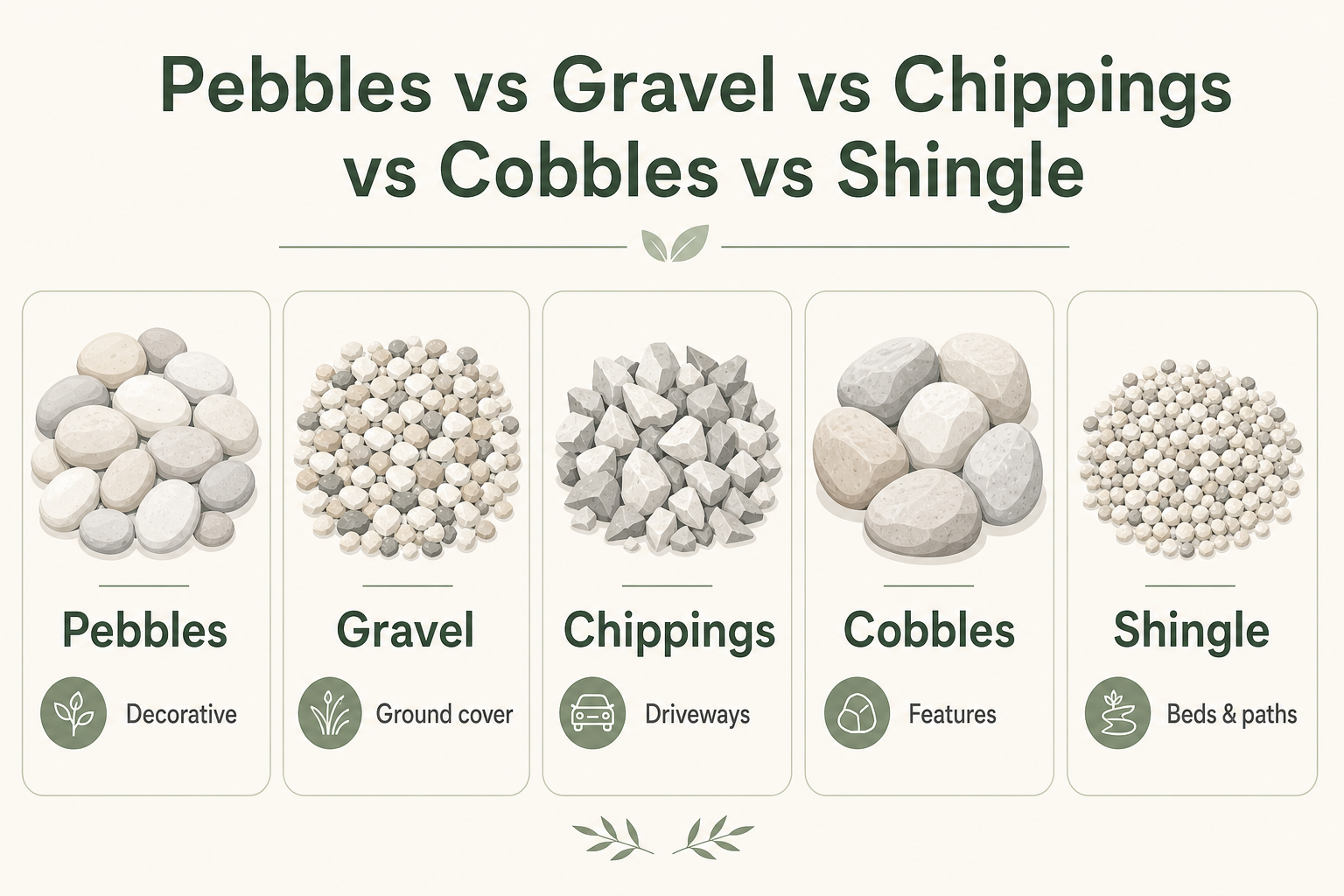
First, the Format: Pebbles vs Gravel vs Chippings vs Cobbles vs Shingle
Before you even think about material, decide on the format — the shape and size of the stone. This one decision changes the look, the price and how it feels underfoot more than most people expect.
| Format | Shape & size | Best for | Feel underfoot |
|---|---|---|---|
| Pebbles | Rounded, tumbled — typically 10–100 mm | Borders, pots, water features, feature beds, decorative dressing | Smooth, comfortable, premium look |
| Gravel | Small angular or rounded, ~6–20 mm | Paths, ground cover, large areas on a budget | Loose, crunchy, can migrate |
| Chippings | Angular, crushed, ~10–20 mm | Driveways, paths — the angular edges lock together | Firm, sharp, good for traffic |
| Cobbles | Large rounded, ~50–150 mm+ | Statement features, dry river beds, edging, low-traffic accents | Chunky — not for walking on |
| Shingle | Small rounded, ~6–14 mm (often dredged) | Beds, paths, general ground cover | Loose, small, easy to spread |
The quick rule
- Want the crisp, decorative "designer" look? Choose pebbles — rounded and tumbled, they photograph beautifully and are kind to bare feet and pets.
- Covering a big area cheaply? Gravel, shingle or chippings stretch further per pound.
- Building a driveway? Angular chippings — they interlock and resist rutting where rounded stones roll.
- Making a bold feature? Cobbles — a little goes a long way visually.
Our Snow-White Thassos pebbles come in 10–30 mm (pot-topping and tight borders), 30–60 mm (all-round borders and paths) and 60–100 mm (features and cobble-style beds). Not sure on size? See our what size pebbles for garden guide.
White Stone by Material: Marble, Spar, Limestone, Granite, Quartz & Dolomite
This is where most confusion (and disappointment) happens. Two bags both labelled "white" can look wildly different because the underlying rock is different. Here's how the common UK white stones actually compare.
| Material | Whiteness | Hardness / porosity | Typical price | Best for |
|---|---|---|---|---|
| Thassos marble (Greek) | Purest, luminous bright white — no undertone | Soft, porous (calcite) — placement matters | Premium | Feature borders, pots, water features, memorials — anywhere the white is the point |
| Dolomite (Turkey/E. Europe) | Bright white, subtle warm or grey cast depending on quarry | Fairly hard carbonate | Mid | Borders and beds where a good white is enough |
| White spar / "polar white" | White with a slight grey/blue sparkle; can look cool | Hard, low porosity | Budget–mid | Driveways, paths, larger areas on a budget |
| White limestone | Off-white to cream — rarely a true bright white | Soft, porous — dulls and dusts | Budget | Rustic/cottage looks, informal ground cover |
| White granite | White flecked with grey/black — a speckled white, not pure | Very hard, durable | Mid | High-traffic paths and drives where durability beats colour purity |
| White quartz / quartzite | Bright, sometimes translucent sparkle; can be slightly icy | Very hard, low porosity — resists algae well | Mid–premium | Shaded or damp spots where you want maximum stay-clean performance |
What "polar white" actually is
"Polar white" is a trade name, not a rock type — it's usually a white spar or crushed marble/granite chipping sold under a brand label. It's a popular, affordable driveway and path stone, but it's typically angular and carries a cooler, slightly grey sparkle rather than the warm, pure white of a good marble pebble. If you searched polar white gravel expecting Mediterranean-white rounded pebbles, that's the mismatch to be aware of.
Marble & limestone are softer — and that's a trade-off, not a fault
Marble and limestone are calcium-based, so they're softer and more porous than spar, granite or quartz. The payoff is colour: nothing matches a good marble for a pure, glowing white. The catch is that in damp shade they need better groundwork and occasional cleaning. Harder stones (quartz, granite, spar) shrug off algae longer but rarely hit the same brilliant white. Our stay-white guide covers how to get the best of marble outdoors.
Which Is Genuinely the Whitest? (And Which Look Grey)
The single most common complaint about white stones is: "it looked grey when it arrived" or "it went grey once it was wet." Here's the honest ranking for pure, bright whiteness.
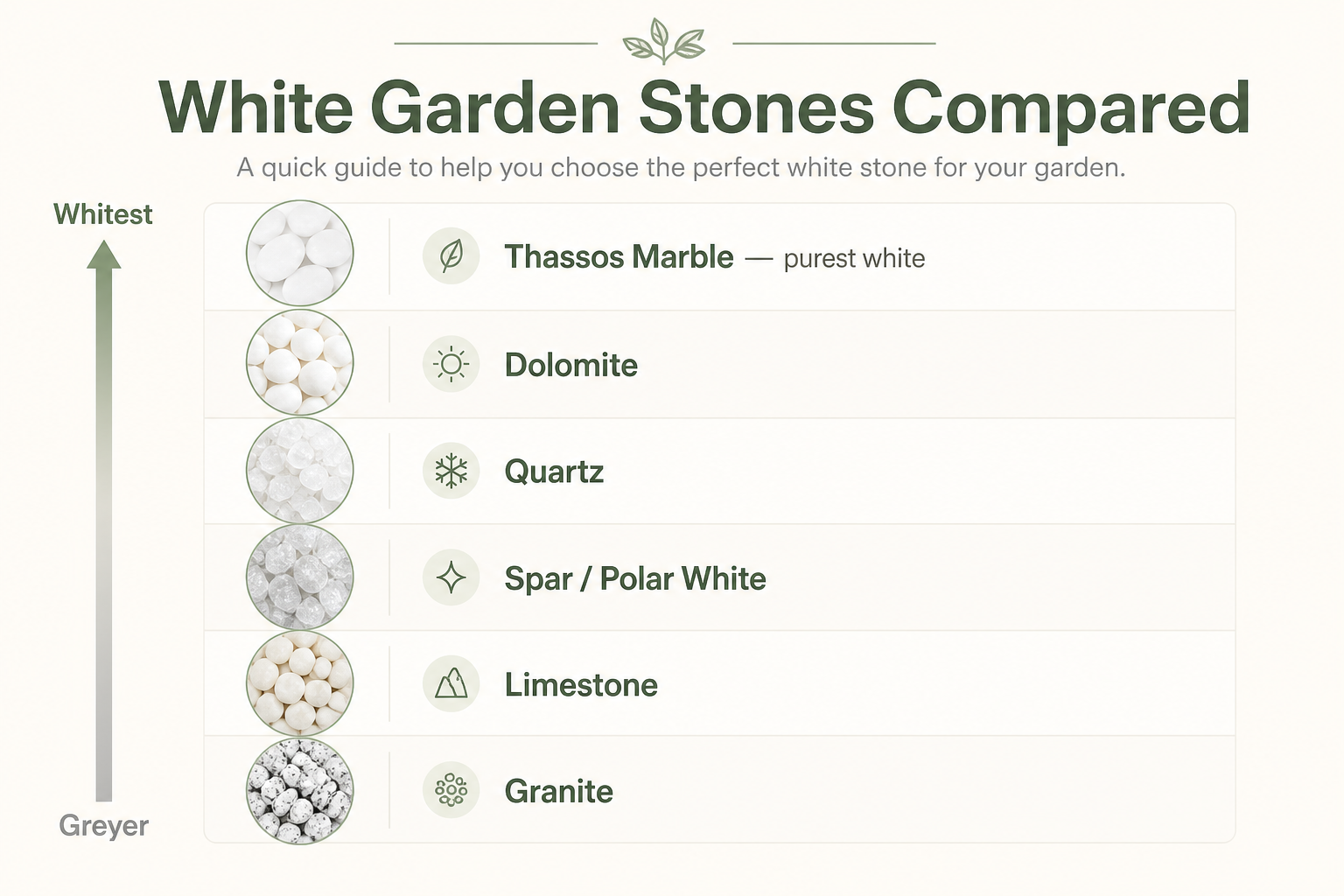
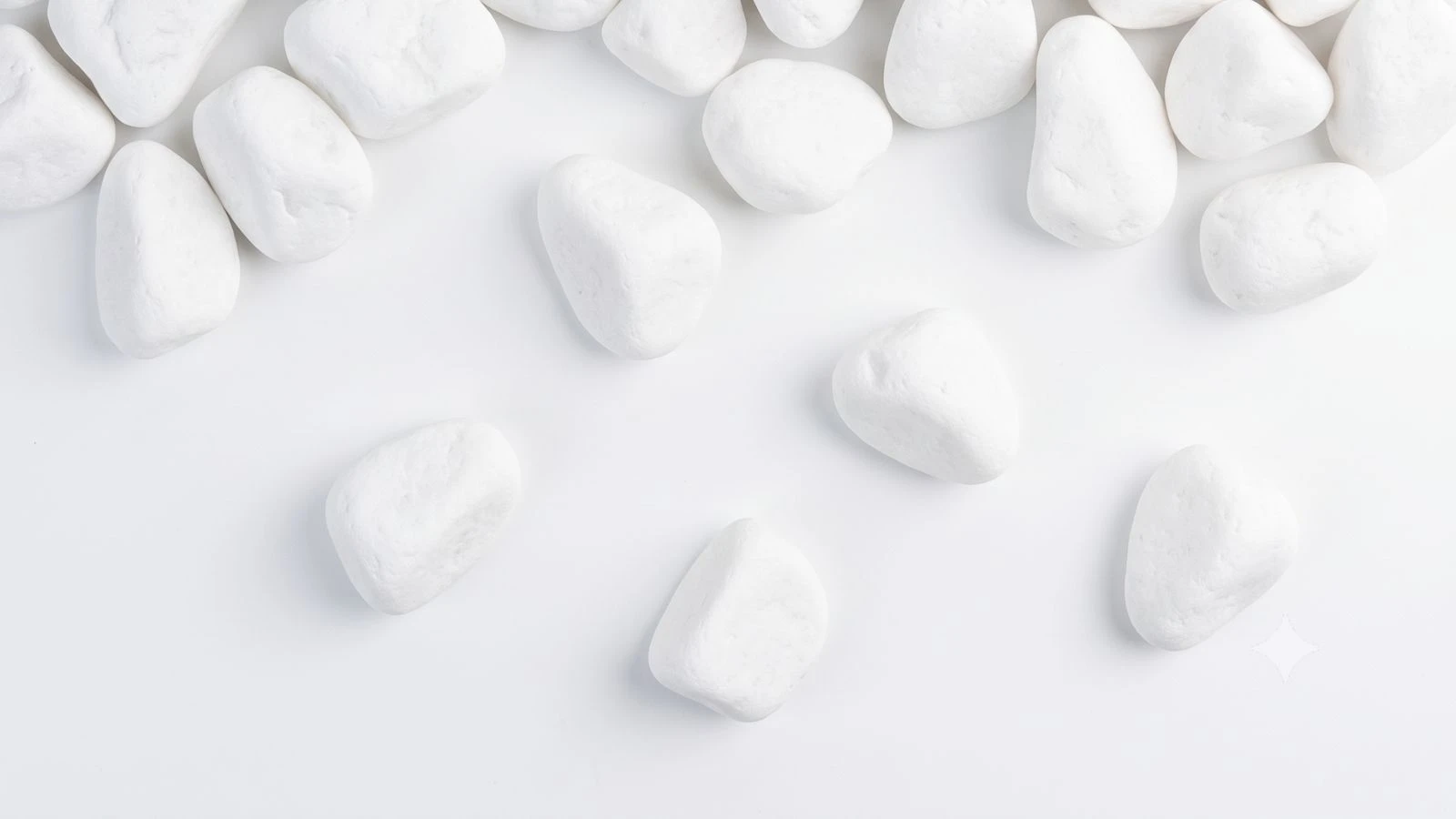
- Thassos marble — the benchmark. A crystalline calcite from a single Greek island quarry with almost no mineral impurity, so there's no grey or yellow undertone. It even stays white (with a subtle glow) when wet.
- Good dolomite — can be very white, but batches vary; some carry a faint grey or warm cast, most noticeable side by side or when damp.
- Quartz — bright but often icy or slightly translucent rather than a soft warm white.
- Spar / "polar white" — white with a cool grey-blue sparkle; reads greyer in shade or when wet.
- Limestone — usually off-white or cream, not a true white, and dulls fastest.
- White granite — a speckled white; lovely and tough, but never pure.
Why stones "go grey" when wet
Every stone darkens when wet — water fills surface pores and cuts reflection. The difference is how much. Porous, impure stones drop a lot of brightness; a dense, pure white like Thassos barely shifts. If a permanently crisp white matters (memorials, front-of-house, photography), start from the whitest base you can, because no amount of cleaning turns a grey stone bright white — though a proper clean will always recover a genuinely white stone that's simply gone dirty or green.
This is exactly why buyers who searched genuine white pebbles not grey or whitest pebbles for garden end up on our Snow-White Thassos Marble Pebbles — and why we always suggest ordering a sample and wetting it in your own garden before committing.
Match the White Stone to Your Project
The "best" white stone depends entirely on where it's going. Here's how to choose by use case.
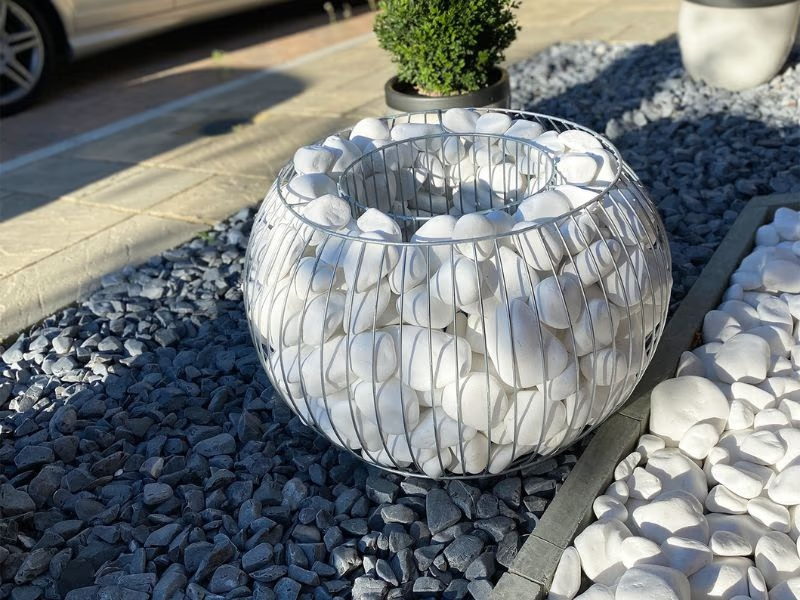
The same white stone can look completely different depending on the setting — bright and Mediterranean against dark planting, or cool and modern beside grey paving.
Before committing to a large order, it pays to see your chosen stone in the exact spot it's destined for, in both sun and shade, so the finished look matches what you pictured.
Borders & decorative beds
Go for rounded pebbles in 10–30 mm or 30–60 mm. This is where marble earns its keep — the pure white contrast against green foliage and dark soil is the whole point. See best stones for garden borders.
Pots, planters & indoors
Small 10–30 mm pebbles. Indoors there's no rain or algae, so bright marble stays crisp indefinitely — the easiest way to guarantee permanent white. See pebbles for indoor plant pots.
Driveways & high-traffic paths
Choose angular chippings — spar, "polar white", granite or quartz. They interlock and cope with vehicle weight far better than rounded pebbles, and their harder surface stays cleaner under traffic. Colour purity is a fair trade for durability here.
Water features & dry river beds
Larger 60–100 mm pebbles or cobbles. Marble looks stunning submerged, where the white intensifies. For stocked fish ponds, check compatibility first — see fish-friendly pebbles for ponds.
Memorials & graves
A pure, consistent white conveys dignity and needs little upkeep in open, sunny positions — Thassos marble pebbles are a popular choice, kept bright with an occasional rinse.
Mediterranean & modern minimalist gardens
The crisp Med look lives or dies on whiteness — this is a job for the purest marble, not a grey-cast budget stone. Pair with architectural planting and dark edging for maximum contrast.
What It Costs & How Much You'll Need
White stones span a wide price range, and it's easy to under- or over-order. Here's how to budget sensibly.
Price positioning (rough guide)
- Budget: white limestone, some spar/"polar white" chippings — cheapest per tonne, best for large areas where colour purity isn't critical.
- Mid: dolomite, granite, better spar grades — a solid white for typical borders and paths.
- Premium: Thassos marble pebbles — the whitest, most consistent finish, chosen where the stone is the visible centrepiece.
A useful way to think about it: pebbles are usually the most-seen element of a project — the part every visitor notices first — yet often a small fraction of the total cost once you add membrane, edging and labour. Spending up on the visible layer is frequently the best-value decision.
How much do you need?
As a rule of thumb, budget roughly 80–100 kg per m² at a 40–50 mm depth for typical pebble sizes (larger sizes need more). The quickest way is to use our coverage calculator below — pop in your dimensions and it works out the exact weight, the best-value bag mix and a ready-to-checkout basket with your PebbleFinder discount applied. To do it by hand:
- Measure your area in m².
- Use howmuchgravel.co.uk or our how much gravel do I need guide to convert to weight.
- Add ~10% for spreading loss and settling.
Bulk bags & delivery
For anything above a small border, buying by the bulk / dumpy bag is far cheaper per kg than handled 20 kg sacks. Our Snow-White Thassos pebbles are sold from samples up to bulk, and our bulk bag delivery guide explains sizes, access and offloading so you don't get caught out on delivery day.
Always sample first. White stone looks completely different on a screen versus in your garden light, wet versus dry. Order a sample bag, live with it through a bit of weather, then scale up with confidence.
How much white stone do I need?
Enter your border, bed or path dimensions and we'll calculate the exact weight, pick the best-value bag mix of Snow-White Thassos marble pebbles, and build a Stones4Gardens basket with your 10% PebbleFinder discount already applied.
Paths, garden borders, pool surrounds
Enter the size of the area to see the bag mix and price.
Shop the Whitest White: Snow-White Thassos Marble Pebbles
Pure Greek Thassos marble in three sizes — the brightest, most consistent white pebble available in the UK, and the benchmark every other white stone is measured against.


Pro tips
Decide format before material
Pebble, gravel, chipping, cobble or shingle changes the look and cost more than the rock type does. Nail the format for your use (rounded pebbles for decoration, angular chippings for drives) first, then choose the whitest material you can afford within it.
Judge whiteness wet, not just dry
Every stone darkens when wet — cheaper, porous whites lose the most brightness. Order a sample, hose it down, and check it in shade as well as sun before buying in bulk.
Buy budget stone for scale, premium stone for the spotlight
Use affordable spar or limestone for large, less-visible ground cover, and reserve premium Thassos marble pebbles for the feature areas people actually look at.
Frequently asked questions
What is the whitest garden stone you can buy in the UK?
Thassos marble is the whitest widely available option — a pure crystalline Greek marble with virtually no grey or yellow undertone, and it holds its white even when wet. Our Snow-White Thassos Marble Pebbles are the only genuine Thassos marble pebbles from a UK garden stone supplier. Dolomite and quartz can be bright too, but tend to carry a subtle grey or icy cast.
What's the difference between white pebbles, gravel and chippings?
Pebbles are rounded and tumbled (decorative, smooth underfoot); gravel is small and loose (budget ground cover); chippings are angular and crushed (they interlock, ideal for driveways and paths). Cobbles are large rounded stones for features, and shingle is small rounded stone often used for beds. Choose the format for your use, then pick the material.
Is white spar or "polar white" the same as white marble?
No. "Polar white" is a trade name, usually for white spar or crushed marble/granite chippings — hard, angular and affordable, with a cooler grey-blue sparkle. It's great for driveways and large areas on a budget, but it doesn't match the pure, warm white of tumbled Thassos marble pebbles. If you want the Mediterranean look, marble pebbles are closer to it.
Which white stone is best for a driveway?
Angular chippings — spar, "polar white", granite or quartz. Their edges lock together and resist rutting under vehicle weight, whereas rounded pebbles roll and scatter. Harder stones also stay cleaner under traffic. Save the softer, purer-white marble pebbles for decorative borders and features rather than drives.
Why did my white stones look grey when they arrived?
Usually because the underlying rock isn't a pure white — many budget "white" gravels are actually off-white spar or limestone with a grey cast, which becomes obvious in shade or when wet. No cleaning turns a grey stone bright white, so start from the whitest base you can and always check a wet sample first.
Are white marble pebbles more expensive than other white stones?
Yes — premium marble like Thassos costs more than budget spar or limestone. But pebbles are the most visible part of a project and often a small share of the total once membrane, edging and labour are added. For feature areas, the uplift is usually modest for a noticeably better, longer-lasting white.
Do all white garden stones need weed membrane underneath?
For light-coloured stone, yes — heavy-duty woven membrane (95–100 gsm+) is essential to stop soil staining the stone from below and to suppress weeds. This matters even more for porous whites like marble and limestone. See our how to lay decorative stones guide.
Related guides
Do White Pebbles Discolour? How to Keep Them White & Stop Them Going Green
Yes — outdoor white pebbles discolour from algae, leaves and soil, not because the stone itself changes colour. How to stop it, plus the Thassos marble and invisible sealer that stay brightest in UK gardens.
Read guide →
How to Clean White Pebbles & Garden Stones (and Make Them White Again)
How to clean white pebbles, stones and gravel: remove algae and green, lift dirt and stains, and make dull white stones bright white again — step by step.
Read guide →
Sealing Garden Stones & Pebbles: Why, How and Is It Worth It?
Should you seal garden stones? Honest UK guide to why sealing decorative stone and pebbles helps, how easy it is, and how to apply EKSIL EH17 — a breathable, colour-neutral stone sealer.
Read guide →
Snow-White Thassos Marble Pebbles: The Brightest White Stone for UK Gardens
Pure Greek Thassos marble pebbles — the brightest white stone in the UK. Three sizes for paths, borders, pots and water features, with care tips and prices.
Read guide →
What Size Pebbles Do You Need? The Complete UK Guide
Find the right pebble size for borders, paths, driveways, ponds, and planters. Covers 8mm to 120mm with coverage rates, pricing, and real UK examples.
Read guide →
Want the whitest white without the grey? Shop Snow-White Thassos Marble Pebbles at Stones4Gardens — 10–30 mm, 30–60 mm and 60–100 mm from samples to bulk — or order a sample and compare it against any other white stone in your own garden light.