Sealing Garden Stones & Pebbles: Why, How and Is It Worth It?
Sealing won't turn natural stone into something it isn't — but on porous stone like marble, sandstone and slate it genuinely slows staining, dulling and greening. Here's when it's worth it, and exactly how to apply EKSIL EH17 — the breathable, colour-neutral sealer we use.
If you've searched how to keep white stones white, how to stop pebbles going green, or do you need to seal marble, you've already found the honest answer: natural stone is porous. It drinks in water, dirt and organic matter — and that's what causes dulling, brown patches and algae over time. Sealing (impregnating) the stone is the single most effective way to slow all three down.
In short: a stone sealer — also called a stone sealant or impregnator — is a liquid that soaks into porous stone and makes it repel water, dirt and stains, so grime rinses off instead of soaking in. On pale, porous stone in the UK it's usually well worth it.
This guide explains, without hype, what a stone sealer actually does and how easy it is to apply — built around EKSIL EH17 Stone Sealer, the water-based, breathable impregnator supplied by Stones4Gardens that's specifically suited to porous natural stone and white pebbles and does not change the colour of the stone.
It's the finishing touch on any white-stone project — whether you're laying our best-selling Snow-White Thassos marble pebbles, Snow-White Thassos gravel or Bianco Carrara white gravel. Browse the full white pebbles & gravel range, or grab a sample to test first.
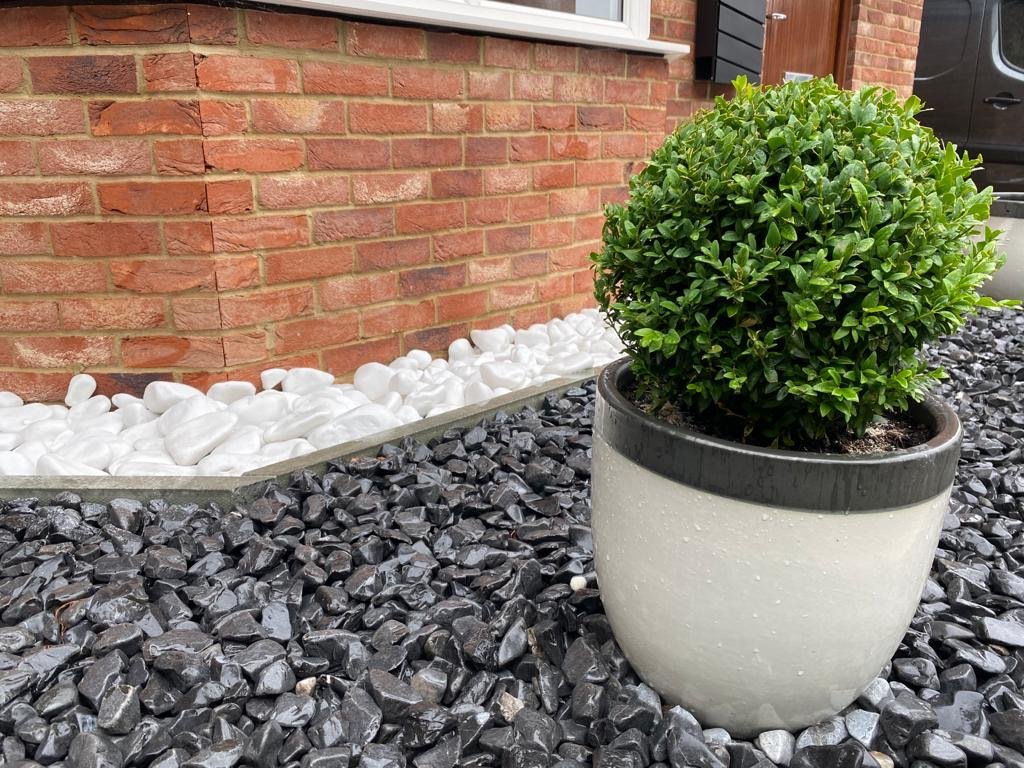
EH17 at a Glance
- Type
- Water-based silane impregnator
- Finish
- Invisible — no colour change
- Best for
- Marble, sandstone, slate, white pebbles
- Key traits
- Breathable · UV-resistant · low VOC
- Coverage
- ~4–8 m² per litre
- Cure
- Dries 1–2 h · keep rain off 4 h
- Sizes
- 100 ml sample · 2 L · 5 L · 20 L
Why Seal Garden Stones? What Sealing Actually Does
Because they're natural products, decorative stones are porous — they absorb liquids like water and oils through tiny capillaries. Left untreated, that porosity is exactly what lets in the dirt, grease and organic matter that dull and stain a surface over time. A water-repellent impregnator like EH17 is drawn deep into those pores and makes the stone far less absorbent — so water and stains bead on top instead of soaking in, without changing the character of the stone.
A common myth is that polished stone doesn't need sealing. That's wrong: polished or not, porous stone — marble included — benefits from impregnation to protect the finish against the British weather.
The things a good sealer helps with
- Staining — leaf tannins, soil, bird lime and grease sit on the surface and rinse away before they mark the stone.
- Dulling & discolouration — less absorbed grime means pale stone keeps its bright, crisp look for longer between cleans.
- Greening, mould & algae — by reducing water uptake and capillary diffusion, EH17 helps the surface dry faster and reduces the formation of mould, fungi and salt efflorescence (the white bloom you sometimes see) — a big deal on white and light stone.
- Frost & freeze-thaw — less water inside the stone means better frost resistance through winter.
Be realistic about what sealing is not: it isn't a force field. In deep shade under dripping trees, even sealed white marble pebbles will still need the occasional rinse. But sealing meaningfully lengthens the gaps between cleans and helps stone recover its look afterwards. Pair it with our keep white pebbles white guide for the full placement-and-cleaning picture.
Meet EH17: A Breathable, Colour-Neutral Stone Sealer
EKSIL EH17 Stone Sealer is the water-repellent impregnator (stone sealant) Stones4Gardens supplies for decorative stone. It's a modern silane-based, water-based formula (no solvents), designed to strengthen and protect mineral surfaces against water penetration — while staying completely invisible on the stone. Unlike a satin or gloss sealant, it leaves a natural matt finish and improves freeze-thaw / frost resistance too.
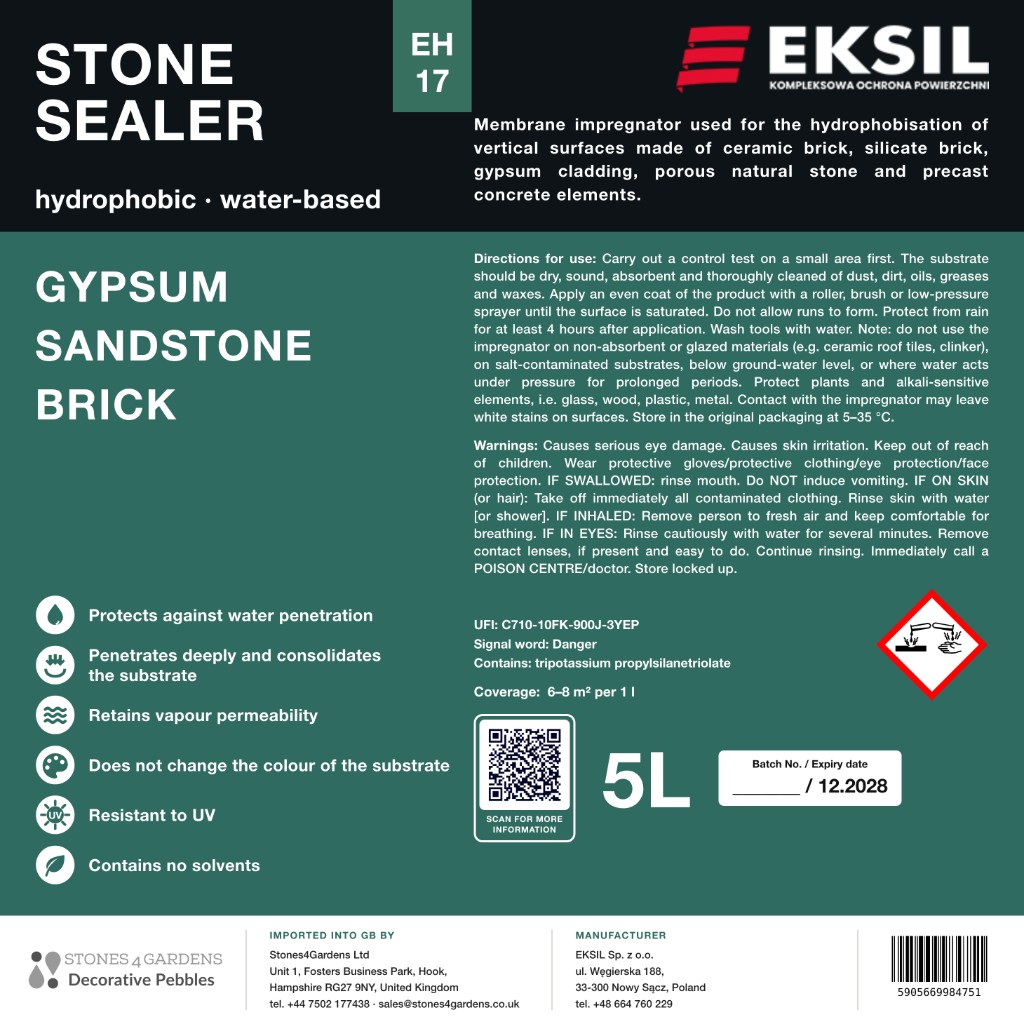
What makes it a good match for garden stone and, especially, bright white pebbles:
- No colour change — transparent protection; it won't darken or yellow your stone (unlike wet-look sealers)
- Breathable — vapour-permeable, so trapped moisture escapes and the stone doesn't stay damp underneath
- Fast water beading — a strong hydrophobic effect that sheds rain
- Deep penetration & consolidation — soaks in and helps bind the surface
- UV-resistant and low VOC (<30 g/l), with easy water clean-up
| Property | EH17 Stone Sealer |
|---|---|
| Base | Water-based, silane impregnator (solvent-free) |
| Appearance | Colourless, odourless liquid — no colour change |
| Finish | Natural / invisible (matt), not wet-look |
| Coverage | ~4–8 m² per litre (depends on porosity) |
| Drying time | 1–2 hours; keep rain off for 4 hours |
| Application temp | 5–35°C, dry conditions |
| Pack sizes | 100 ml test sample · 2 L · 5 L · 20 L |
| Shelf life | 24 months (store 5–25°C, protect from frost) |
A 100 ml test sample is available, which is the smart way to trial it on an offcut or a hidden patch before treating a whole area.
Which Garden Stones Benefit — and What EH17 Works On
The more porous and the paler the stone, the bigger the payoff from sealing. Very hard, low-porosity stones benefit far less. EH17 is formulated for absorbent, mineral surfaces.
EH17 is suited to
- Porous natural stone and white pebbles — like our Snow-White Thassos marble pebbles, Thassos marble gravel, Bianco Carrara pebbles and Bianco Carrara gravel
- Sandstone and slate
- Paving stones, concrete and precast elements
- Ceramic & silicate brick, gypsum and plaster (great for stone walls)
Don't use it on
- Non-absorbent or glazed materials — there are no pores for it to work into
- Salt-contaminated substrates, surfaces below the water table, or anywhere under prolonged pressurised water
- Very hard, naturally water-resistant stone like granite or quartzite rarely needs it
| Stone type | Porosity | Seal with EH17? |
|---|---|---|
| White marble (Thassos, Carrara) | Soft & porous | Highly recommended — best return; slows greening, keeps the white bright, no colour change |
| Sandstone & limestone | Very porous | Recommended — prone to staining and moss otherwise |
| Slate (e.g. tumbled black slate) | Moderately porous, layered | Yes — sheds water and reduces salt bloom |
| Paving, concrete & brick | Porous | Yes — classic use; improves frost resistance |
| Granite & quartzite | Hard, low porosity | Rarely needed — naturally resists water |
Sealing loose pebbles and gravel is mainly about stain resistance and easier upkeep — spray a saturating, even coat over the laid stone (or treat before laying for full coverage). If you're still choosing stone, our types of white garden stones and snow-white marble pebbles guides cover the porous, seal-friendly options — or jump straight to the white pebbles & gravel collection and order a sample.
Why “No Colour Change” Matters (EH17 vs Wet-Look Sealers)
The biggest surprise for first-time sealers is that the sealer you choose changes how the stone looks — permanently, until you re-seal. There are broadly three finishes:
- Wet-look / gloss — a permanently-wet, glossy sheen. High impact, but it darkens the stone.
- Colour-enhancing — deepens the natural tones without full gloss.
- Natural / invisible (impregnating) — soaks in and protects with no visible change. This is what EH17 is.
Why this matters for white pebbles: a wet-look or colour-enhancing sealer will noticeably darken or yellow bright white marble — the opposite of what you want. Because EH17 is a colourless, UV-resistant impregnator that does not change the surface colour, it protects stone like Snow-White Thassos — in 10–30 mm, 30–60 mm or 60–100 mm — while keeping that crisp, luminous white intact.
The trade-off: an invisible impregnator won't give you that glossy "just rained" look some people love on dark paving. If you specifically want gloss, that's a different product. For keeping decorative stone — especially pale stone — looking natural and protected, invisible is exactly right.
Clean First: How to Clean Pebbles & Gravel Before Sealing
This step is non-negotiable: never seal dirty or damp stone. A sealer locks in whatever is on the surface, so any dirt, algae or staining gets trapped underneath. Cleaning first is also the answer to the most common question we get — how to clean white pebbles and gravel in the garden, and how to stop white gravel going green.
How to clean garden pebbles & gravel
- Clear the debris. Remove leaves, twigs and loose soil with a rake or a leaf blower on low — organic matter is what feeds staining and algae.
- Rinse and agitate. Hose the stone down; for stubborn grime, a pressure washer on a wide fan setting works well on tumbled pebbles and gravel. For loose stone you can also rinse it in a bucket or sieve.
- Treat green algae. To stop white gravel or pebbles going green, spot-treat with a natural-stone-safe algae remover (follow the label; protect nearby planting). Avoid harsh bleach outdoors, which harms soil and plants.
- Let it dry fully. The surface must be completely dry before sealing — plan a dry spell, as damp stone won't take the sealer.
For the full method — reviving stone that's gone dull or green, batch-washing loose pebbles and stubborn stains — see our dedicated how to clean white pebbles & gravel guide. For placement, membrane and ongoing care, see keep white pebbles white. Once the stone is clean and dry, you're ready to seal.
How to Apply EH17: Step-by-Step (It's Easier Than You Think)
Sealing is genuinely a simple, satisfying job — the results depend far more on prep and weather than on skill. Always read the product label, but here's the EH17 method:
- Clean & dry first. The surface must be clean and completely dry. Sealing over dirt or damp traps the problem underneath — clear debris, wash if needed, and let it dry fully.
- Do a test patch. Trial it on a small, hidden area (or an offcut / the 100 ml sample) and let it cure — check you're happy with how the stone looks and behaves first.
- Protect the surroundings. Cover or move nearby plants, and keep it off alkali-sensitive materials — glass, wood, plastics and metal. Wipe any accidental contact promptly, as white marks can appear on contact.
- Apply an even, saturating coat. Use a brush, roller or low-pressure sprayer (a sprayer is easiest for loose pebbles and gravel). Work it in until the surface is saturated — avoid puddles and run-off marks.
- Two coats, wet-on-wet. For reliable protection, apply a second coat using the "wet-on-wet" method (before the first dries), or a single coat until fully saturated.
- Keep rain off for 4 hours. Protect the freshly-treated area from rain for at least 4 hours; it's touch-dry in about 1–2 hours.
- Work in the right conditions. Apply in dry weather between 5°C and 35°C — plan around the British forecast. Then wash your tools with plain water.
Coverage & quantities: budget for roughly 4–8 m² per litre depending on how thirsty the stone is (porous stone drinks more). A 5 L can therefore covers a good-sized bed or patio; 20 L suits larger projects. Grab the 100 ml sample first to test.
Laying a new area at the same time? Get the groundwork right first — see how to lay decorative stones for membrane, depth and edging, then seal once everything is clean and dry. Still need the stone? Shop Snow-White Thassos pebbles and the wider white range.
Re-sealing, Aftercare & Handling EH17 Safely
Sealing isn't strictly one-and-done, but it's low effort to keep up.
How often to re-seal
- Simple test: when water stops beading and starts soaking in again, it's time for a fresh coat.
- Exposed paving & high-traffic areas wear faster than decorative pebble beds, which are walked on less and tend to last longer between coats.
- Re-clean, dry, and re-apply exactly as before.
Everyday aftercare
- Monthly: clear leaves and debris so nothing sits and stains.
- As needed: rinse or hose down — sealed stone cleans up fast.
- Occasionally: spot-treat algae with a natural-stone-safe cleaner; avoid harsh abrasives that degrade the treated surface.
Safety first (EH17 is classified Danger). It's an alkaline formula that causes serious eye damage and skin irritation. Wear gloves and eye/face protection, work in a ventilated spot, keep it out of reach of children and store it locked up, cool and frost-free. It's water-based, low-VOC and non-flammable, but protect plants and surrounding surfaces during application, and don't let it enter drains or watercourses. Always follow the product label and safety data sheet.
Combine sealing with smart placement and membrane for the best result — our keep white pebbles white guide covers the full care system that works alongside sealing.
Porous Stone That Loves a Seal
These pale, porous marble stones get the biggest return from sealing with EH17 — bright, stain-resistant and easier to keep clean, with no change to their natural colour. See the full white pebbles & gravel range.


Pro tips
Always test the 100 ml sample first
Even a colour-neutral sealer behaves differently on different stone. Trial EH17 on a hidden patch or offcut, let it cure, and confirm you're happy before treating the whole project — it's the cheapest insurance there is.
Seal on a dry, mild, rain-free day
Prep and weather matter more than skill. Work on clean, dry stone between 5°C and 35°C, apply two coats wet-on-wet, and keep rain off for at least 4 hours while it sets.
EH17 is the right choice for white marble
Because it's colourless and UV-resistant and doesn't change the surface colour, EH17 protects bright pebbles like Snow-White Thassos without the darkening or yellowing you'd get from a wet-look sealer.
Protect plants, glass and metal
Move or cover nearby planting and keep the sealer off glass, wood, plastic and metal. Wipe accidental splashes promptly and wear gloves and eye protection — it's an alkaline formula.
Frequently asked questions
Will EH17 change the colour of my stones?
No. EH17 is a transparent, colourless impregnator that does not change the surface colour — it protects invisibly and keeps the stone's natural look. That's the opposite of a wet-look or colour-enhancing sealer, which darkens the stone. It makes EH17 ideal for bright white marble pebbles that you don't want to yellow or darken.
Does sealing stop garden stones going green?
It helps a lot but isn't a guarantee. By cutting water uptake and capillary diffusion, EH17 helps the surface dry faster and reduces the formation of mould, fungi and salt efflorescence — slowing that green film significantly. In deep, damp shade you'll still need the occasional rinse. Sealing works best alongside good drainage, membrane and sun; see our keep white pebbles white guide.
Do you need to seal marble pebbles?
It's optional but recommended. Marble is a soft, porous calcite stone, so sealing genuinely slows staining and dulling and keeps the white brighter for longer — and improves frost resistance. Polished marble still benefits; the myth that polished stone doesn't need sealing is wrong. EH17 is specifically suited to porous natural stone and white pebbles.
Which stones can I use EH17 on?
EH17 is suited to porous, absorbent surfaces: porous natural stone and white pebbles, sandstone, slate, paving stones, concrete, and ceramic or silicate brick, gypsum and plaster. Don't use it on non-absorbent or glazed materials, salt-contaminated substrates, below the water table, or where water sits under pressure. Very hard granite or quartzite rarely needs sealing.
How much EH17 do I need, and what sizes does it come in?
Budget roughly 4–8 m² per litre depending on how porous the stone is (porous stone absorbs more). EH17 comes in a 100 ml test sample plus 2 L, 5 L and 20 L — a 5 L can covers a good-sized bed or patio, and 20 L suits larger projects.
How do I actually apply it, and how many coats?
Clean and fully dry the stone, do a test patch, then apply an even, saturating coat by brush, roller or low-pressure sprayer — avoiding puddles and runs. Apply two coats using the wet-on-wet method (or one coat until saturated). Keep rain off for 4 hours; it dries in 1–2 hours. Work between 5°C and 35°C and wash tools with water.
Is EH17 safe for plants and pets?
It's a water-based, low-VOC, non-flammable product, but during application it's classified Danger (alkaline; causes serious eye damage and skin irritation), so wear gloves and eye protection, keep it out of reach of children, and protect nearby plants and surfaces. Don't let it enter drains or watercourses. Once applied and cured to the stone it forms an inert, invisible water-repellent layer.
How do I clean white pebbles or gravel before sealing?
Clear leaves and debris, then hose the stone down — a pressure washer on a wide fan setting shifts stubborn grime on tumbled pebbles and gravel. Spot-treat any green algae with a natural-stone-safe cleaner (avoid harsh bleach outdoors), then let it dry completely. Sealing over dirt or damp traps the problem underneath, so clean and dry always comes first. Our keep white pebbles white guide has the full routine.
Should I seal my patio, and how?
If it's natural stone, sandstone, limestone, concrete or paving slabs, sealing is worth it — it resists staining, slows moss and improves frost resistance. Clean and fully dry the patio first, mask off edges and planting, then apply EH17 evenly with a brush, roller or low-pressure sprayer (two coats wet-on-wet), keeping rain off for 4 hours. Don't seal glazed or non-porous porcelain tiles — there are no pores for it to work into.
What's the difference between a stone sealer, a sealant and an impregnator?
They're largely the same idea — a liquid that protects stone from water and stains. “Impregnator” specifically means it soaks in and works from within (like EH17), rather than forming a surface film. A breathable impregnator lets moisture vapour escape, which is why it's the right choice for outdoor natural stone and walls.
Is sealing garden stone actually worth it?
On pale, porous stone (marble, sandstone, limestone, slate) in the UK climate, yes — it lengthens the gaps between cleans, resists staining, improves frost resistance and keeps the look you paid for. On very hard stones like granite or quartzite the benefit is smaller. Match the effort to the stone.
Related guides
Do White Pebbles Discolour? How to Keep Them White & Stop Them Going Green
Yes — outdoor white pebbles discolour from algae, leaves and soil, not because the stone itself changes colour. How to stop it, plus the Thassos marble and invisible sealer that stay brightest in UK gardens.
Read guide →
How to Clean White Pebbles & Garden Stones (and Make Them White Again)
How to clean white pebbles, stones and gravel: remove algae and green, lift dirt and stains, and make dull white stones bright white again — step by step.
Read guide →
Types of White Garden Stones Compared: Which White Pebbles, Gravel or Chippings to Buy
Compare white garden stones — marble, spar, limestone, granite, quartz and dolomite, plus pebbles vs gravel vs chippings. Which is whitest and best value?
Read guide →
Snow-White Thassos Marble Pebbles: The Brightest White Stone for UK Gardens
Pure Greek Thassos marble pebbles — the brightest white stone in the UK. Three sizes for paths, borders, pots and water features, with care tips and prices.
Read guide →
How to Lay Decorative Stones in Your Garden: Step-by-Step
Step-by-step guide to laying decorative stones in your UK garden: ground prep, membrane, depth by stone size (with Stones4Gardens product examples), edging and stepping stones.
Read guide →
Sealing works best on bright, porous stone. Shop Snow-White Thassos Marble Pebbles in 10–30 mm, 30–60 mm or 60–100 mm, explore the full white pebbles & gravel range (or grab a sample) — then protect it all with EKSIL EH17 Stone Sealer, the breathable, colour-neutral impregnator made for decorative garden stone.