Japanese Garden Pebbles & Cobbles: Flat River Stones for Zen Gardens
Flat river pebbles and cobbles in beige, brown, grey and white — the natural palette for zen, gravel and rock gardens in the UK.
Japanese garden design is built on restraint, natural materials and the suggestion of landscape in miniature. The stones you choose set the tone for the entire space — and getting the wrong colour or shape breaks the illusion before a single plant goes in.

At a Glance
- Type
- River Stone
- Origin
- Portugal
- Shape
- Flat, rounded
- Colour
- Beige, brown, grey, white (natural mix)
- Sizes
- 30–60 mm · 60–120 mm
- Sample price
- From £6.99
- Delivery
- Free, next working day
Our Japanese Multicoloured Pebbles are flat, rounded river stones sourced from Portugal in a natural blend of beige, brown, grey and white. They deliver the warm, layered neutral palette that real Japanese-influenced gardens depend on — without the harshness of bright white gravel or the dullness of plain grey aggregate. Available in 30–60 mm and 60–120 mm, they work for everything from raked gravel beds to stepping-stone infill and border topping.
Why Flat Pebbles Work for Japanese-Style Gardens
Traditional Japanese garden design — from the dry karesansui rock garden to the stroll garden — uses stone to represent water, mountains and shoreline. Flat, rounded pebbles mimic the look of river beds and lake margins, creating a natural feel that angular chippings cannot match.
Key design principles these pebbles support
- Asymmetry and odd groupings — scatter larger 60–120 mm pieces in groups of three or five around a focal boulder
- Calm, muted palette — the beige-brown-grey-white mix avoids the stark contrast of single-colour gravel and blends with UK planting (acer, bamboo, ferns, moss)
- Texture over colour — flat surfaces catch light differently from rounded or angular stone, giving visual depth even in a small courtyard
- Minimal footprint — a 2 m × 3 m raked bed of 30–60 mm pebbles can create a complete Japanese vignette in a typical UK rear garden
Multitone vs monochrome zen

Many UK suppliers push bright white or uniform grey gravel as "Japanese garden stone". In reality, the best Japanese-inspired schemes use warm, layered neutrals that shift with the light and look natural against green foliage. Our multicoloured flat pebbles deliver exactly that variation — and they are far less maintenance-intensive than pure white marble in a damp British climate.
30–60 mm Pebbles vs 60–120 mm Cobbles: Which Size for Your Project
Choosing the right size is more important than most people expect. These pebbles come in two grades — the smaller 30–60 mm pebble and the larger 60–120 mm cobble — and each suits different applications and scales. In practice the 60–120 mm grade is what most UK gardeners mean when they search for garden cobbles or large cobbles for garden use: chunky, smooth, water-worn stones that read as a deliberate design statement.
| Size | Best for | Depth | Notes |
|---|---|---|---|
| 30–60 mm pebbles | Raked zen beds, path infill around stepping stones, borders, small courtyards | 40–50 mm | Sits flatter and more stable underfoot; easier to rake for pattern work |
| 60–120 mm cobbles | Dry stream beds, feature areas, rockery accents, around large boulders | Single layer | Creates a bolder, more sculptural look; best in larger spaces or as contrast to the smaller grade |
For most UK courtyard and rear-garden Japanese schemes, 30–60 mm is the workhorse size. Use the 60–120 mm cobbles as an accent — along a dry stream channel, around a water basin, or where you want the eye to slow down. Many designers combine both: a raked 30–60 mm bed threaded with a winding "river" of 60–120 mm cobbles is one of the most recognisable Japanese-garden looks.
Why 60–120 mm cobbles are so popular in UK Japanese gardens
The larger cobble grade has become a go-to for British zen and gravel-garden projects for three reasons: it covers ground quickly, it holds its position without migrating like small gravel, and — because these are tumbled river stones rather than crushed rock — the rounded, smooth surface is genuinely pleasant to walk on and to handle. That smoothness matters if you plan to lay a stepping area, a reflexology path or a play/craft zone (more on both below).
Need to calculate quantities? Use the built-in coverage calculator below — it works out the exact weight, the cheapest bag mix and a basket with your discount applied. As a rule of thumb, at 50 mm depth you need roughly 80–100 kg per square metre, plus ~10 % for irregular surfaces.
How to Lay Japanese Pebbles: Step-by-Step
Proper groundwork makes the difference between a scheme that lasts years and one that develops weeds and sinks within months.
- Clear and level — remove turf, weeds and organic debris. Treat perennial weeds and wait for dieback before proceeding
- Compact the sub-base — for paths, use 50–75 mm of MOT Type 1 or similar sub-base, compacted with a plate vibrator or heavy roller. For purely decorative beds, firm soil is sufficient
- Lay heavy-duty membrane — use woven landscape fabric (100 gsm+). Overlap joins by at least 150 mm and pin with metal staples every 300 mm. Cut crosses for plants, not holes
- Install edging — metal lawn edging, timber boards or stone kerbs contain the pebbles and prevent migration onto lawns. Flexible metal edging works well for curved borders
- Spread pebbles — pour from bags and rake level. For 30–60 mm, aim for 40–50 mm depth. For 60–120 mm, a single layer is usually enough
- Place feature stones — position any larger accent boulders or stepping stones before filling around them
For a detailed walkthrough, see our how to lay decorative stones guide.
Japanese Garden Ideas for UK Spaces
You do not need a large plot to create a convincing Japanese-influenced garden. These pebbles suit several common UK scenarios:
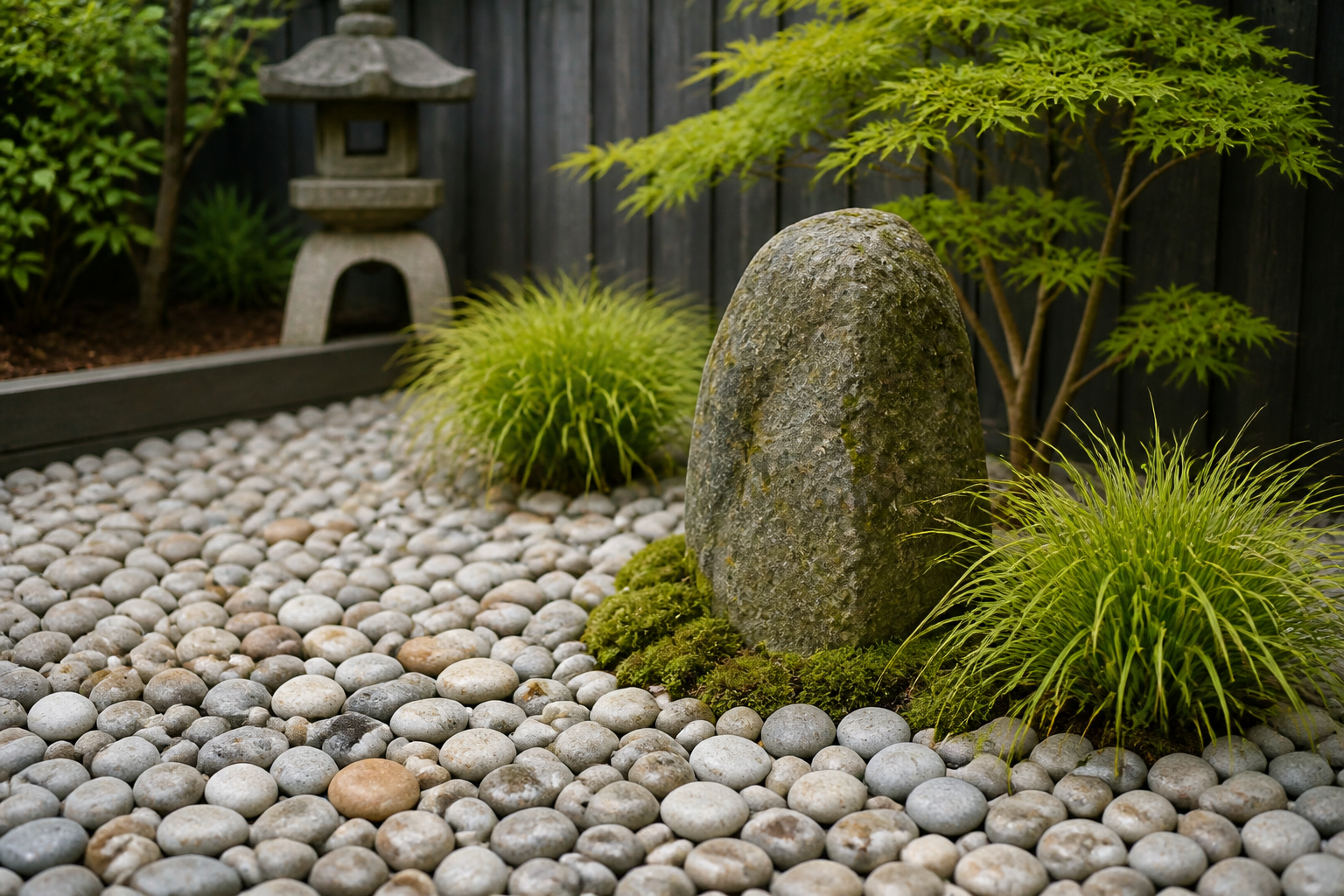
Small courtyard or patio corner
A 2 × 2 m bed of 30–60 mm pebbles with a single upright boulder and three clumps of Hakonechloa grass creates an instant focal point. Edge with steel and position near a seating area for maximum enjoyment.
Stepping-stone path
Set sawn sandstone or slate stepping stones into a bed of 30–60 mm Japanese multicoloured pebbles. The flat pebbles fill the gaps naturally and the warm tones complement grey or buff paving.
Water feature, pond edge or tsukubai
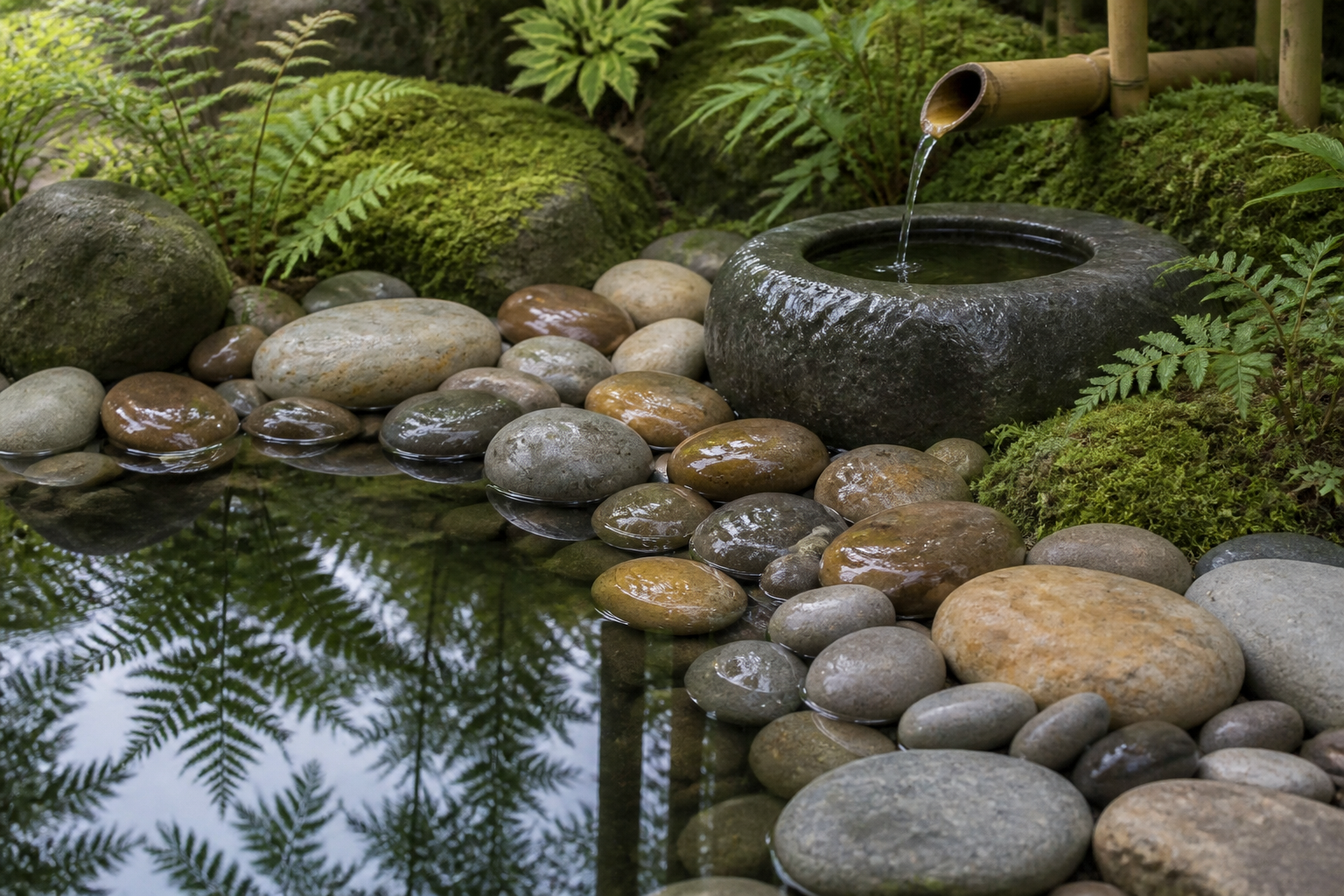
These are inert natural river stones, so they sit happily around ponds, stream beds and a traditional water basin (tsukubai). Use 30–60 mm as the dressing layer and 60–120 mm cobbles to hold the banks. When wet, the beige and brown tones deepen and the greys pick up a soft sheen — the look most people picture when they think of a Japanese water garden.
Dry stream or drainage channel
Dig a shallow, winding trench (200 mm deep × 400–600 mm wide), line with membrane, and fill with 60–120 mm pebbles. Add a few larger cobbles at the "banks" and plant ferns alongside. This creates the illusion of a dried-up brook and doubles as a functional drainage feature.
Border topping around acers and bamboo
Replace bark mulch with 30–60 mm pebbles under specimen trees. The stone will not rot, blow away or harbour slugs, and the muted colours let foliage take centre stage.
Zen, Gravel & Rock Gardens: Which Japanese Style Are You Building?
"Japanese garden" covers several distinct traditions, and the stone you choose — and how you lay it — depends on which one you're recreating. Understanding the differences helps you get an authentic result rather than a generic gravel bed.
| Style | Japanese term | What it is | How to use these pebbles |
|---|---|---|---|
| Dry rock / zen garden | Karesansui (枯山水) | Raked gravel or sand representing water, with carefully placed rocks as islands or mountains | 30–60 mm as the raked "sea"; 60–120 mm cobbles and boulders as islands |
| Gravel garden | — | Low-maintenance ground plane of loose stone, often around a few sculptural plants | 30–60 mm across the whole area, 40–50 mm deep over membrane |
| Stroll / tea garden | Roji (露地) | A path-led garden you move through, with stepping stones, moss and planting | 30–60 mm pebble infill between stepping stones and around plants |
| Courtyard garden | Tsuboniwa (坪庭) | A tiny enclosed garden, often viewed from indoors | A 1–2 m² raked bed of 30–60 mm with a single accent cobble |
Karesansui: the classic dry gravel garden
The most recognisable Japanese style is karesansui — the dry landscape or "zen garden" where raked gravel stands in for water and a few placed stones suggest islands or mountains. Traditionally this uses pale, angular granite grit that holds a raked line, but for a softer, warmer and lower-glare look in the British climate, many UK gardeners now use flat 30–60 mm river pebbles for the raked plane and 60–120 mm cobbles for the "islands". You won't get a razor-sharp rake line in rounded pebbles, but you gain a natural, forgiving surface that doesn't scatter as easily and never dazzles in low winter sun.
Low-maintenance Japanese garden design for UK plots
One reason the Japanese-inspired look has taken off in the UK is that it is genuinely low maintenance. A stone ground plane over quality membrane means no mowing, no bark to top up every year, and no bare soil for weeds. Combine restrained evergreen planting (acer, pine, bamboo, moss, ferns) with a raked or dressed pebble surface and you have a garden that looks composed all year with a few minutes of upkeep a week — ideal for small courtyards, front gardens and low-effort rear plots.
Japanese Stepping Stones & Pebble Paths
Stepping stones — tobi-ishi, literally "flying stones" — are one of the defining features of a Japanese garden. The gaps between and around them are traditionally filled with loose pebbles, which is exactly where our 30–60 mm grade shines.
How to set stepping stones in a pebble path
- Plan the stride — space stones a comfortable, slightly irregular pace apart (roughly 500–600 mm centre to centre). Japanese design favours a gentle, non-uniform rhythm over a rigid grid
- Bed the stones — set sawn sandstone, slate slabs or large flat rounds so their tops sit 20–40 mm proud of the finished pebble level
- Lay membrane and fill — cover the surrounding area with woven membrane and fill with 30–60 mm pebbles to just below the stepping-stone tops
- Blend the edges — tuck a few 60–120 mm cobbles at path junctions and corners to break up the line and stop pebbles wandering
Round stepping stones look especially at home surrounded by these flat multicoloured pebbles, and the warm neutral mix flatters grey, buff or riven paving alike. For the full groundwork sequence, see our how to lay decorative stones guide.
Walking on Smooth Pebbles: Comfort Underfoot & Reflexology Paths
Because these are tumbled river stones rather than crushed aggregate, they are smooth and rounded — noticeably kinder underfoot than sharp gravel or chippings. That opens up two uses that angular stone simply can't offer.
Comfortable to walk on
On paths, stepping-stone infill and seating-area surrounds, the smooth 30–60 mm grade is pleasant to walk across in shoes and won't shred bare feet the way flint or granite grit can. It's also easier on the hands when you're placing or adjusting stones. For heavily trafficked routes, keep the layer to 30–40 mm over a firm compacted sub-base so the surface stays stable.
Barefoot reflexology paths
A reflexology path — a run of rounded pebbles you walk over barefoot to stimulate the soles of the feet — is a genuine feature of many Japanese and wellness gardens. Smooth, flat multicoloured pebbles are ideal for this: set the 30–60 mm stones on edge in mortar or a firm sand bed so their rounded tops form a gently textured, massaging surface. Vary the orientation for a mix of sensations, keep the path narrow (300–400 mm) and short, and add a handrail or nearby wall for balance. Because these pebbles are smooth rather than jagged, the effect is stimulating rather than painful.
Do they need washing before use?
No — the pebbles are supplied clean and ready to lay. For a reflexology or barefoot area a quick rinse after installation removes any transport dust, but it isn't essential.
Pebble & Rock Painting with Flat Japanese Pebbles
Flat, smooth pebbles are the perfect canvas for rock painting and pebble painting — one of the most popular family craft activities in the UK, and a lovely way to add personal touches to a Japanese-inspired garden. The flat faces of these multicoloured pebbles take paint beautifully and give you a stable surface to work on.
Why these pebbles suit rock painting
- Flat, broad faces — the rounded-flat shape gives a natural "canvas" that sits still while you paint, unlike round cobbles that roll
- Smooth surface — tumbled river stone needs little prep; a quick wash and dry is usually enough
- Range of sizes — 30–60 mm pebbles are ideal for small motifs (ladybirds, leaves, kanji, mandalas); 60–120 mm cobbles give room for bolder designs and garden markers
Simple steps for painted garden pebbles
- Wash and fully dry the pebbles
- Optionally prime with a base coat of acrylic
- Paint your design with acrylic paints or paint pens
- Seal with a clear outdoor varnish so the colour survives UK weather
Painted pebbles make charming plant markers, path edging, "kindness rocks" and children's craft projects — and they're an easy way to trial a few stones from a sample bag before committing to a larger order. Zen-inspired designs (single brushstroke enso circles, bamboo, koi) tie the craft back to the garden theme.
How Much Do You Need? (Coverage & Prices)
These flat river pebbles are dense at roughly 1,900 kg/m³ loose, so budget around 80–100 kg per m² at a solid 40–50 mm depth. Use the table for a quick estimate, then the calculator below for exact figures, the best-value bag mix and a basket with your discount pre-applied.
| Area | Depth | Approx. weight | Typical bag mix |
|---|---|---|---|
| 1 m² | 40 mm | ~76 kg | 4 × 20 kg |
| 2 m² | 50 mm | ~190 kg | 1 × 100 kg + 5 × 20 kg |
| 5 m² | 50 mm | ~475 kg | 2 × 200 kg + 4 × 20 kg |
| 10 m² | 50 mm | ~950 kg | 1 × 1000 kg |
All prices include VAT and free next-working-day delivery. Order a sample first if you want to test the colour wet and dry — and grab 3 samples for the price of 1 with code 3FOR1. The calculator below builds a basket with your PebbleFinder 10% discount already applied.
Care and Maintenance
These are natural river stones — they are inherently low-maintenance compared to organic mulches, and far less demanding than bright white marble.
Routine care
- Monthly: clear fallen leaves with a leaf blower or by hand — organic debris left sitting can stain lighter stones over time
- Quarterly: hose the area to shift surface dust and pollen
- Annually: check membrane for tears, especially around plant stems. Top up any areas that have thinned below 40 mm
Wet vs dry appearance

Like all natural stone, these pebbles darken and intensify when wet. The beige and brown tones become richer after rain, and the whites brighten. This is a feature, not a flaw — many gardeners prefer the wet look and install subtle trickle features to keep selected areas permanently glistening.
No washing is needed before use — the pebbles are supplied clean and ready to lay.
How many Japanese pebbles do I need?
Enter your bed, path or dry-stream dimensions and we'll calculate the exact weight, pick the best-value bag mix across 30–60 mm pebbles and 60–120 mm cobbles, and build a Stones4Gardens basket with your 10% PebbleFinder discount already applied.
Raked zen beds, paths, borders, stepping-stone infill
Enter the size of the area to see the bag mix and price.
Shop Japanese Multicoloured Pebbles
Flat, rounded river stones in a natural blend of beige, brown, grey and white — perfect for zen-inspired gardens, paths and borders.


Pro tips
Order a sample and test in your garden
Stone looks different on screen than in your actual garden light. Order a sample bag (from £6.99), scatter it in your planned area and check both the dry and wet colour before committing to a larger quantity.
Stick to odd numbers for feature groupings
Japanese design uses odd numbers — groups of 3, 5 or 7 stones — for natural asymmetry. When placing larger 60–120 mm pebbles as accents, arrange them in odd clusters rather than symmetrical rows.
Pair with plants that suit UK shade
Acers, bamboo, Hakonechloa grasses, ferns and moss all thrive in partial shade and complement the warm neutral tones of these pebbles. Avoid bright bedding plants that clash with the restrained palette.
Combine both sizes for a dry-stream look
The most recognisable zen effect is a raked bed of 30–60 mm pebbles threaded with a winding 'river' of 60–120 mm cobbles. Order both grades together and use the larger cobbles to define the banks and slow the eye.
Seal painted pebbles for the British weather
If you're rock painting these flat pebbles for the garden, finish every stone with a clear outdoor varnish. Acrylic paint alone will fade and flake in UK rain and frost — a sealed pebble keeps its colour for years.
Frequently asked questions
How many kg of Japanese pebbles do I need per square metre?
At the recommended 40–50 mm depth, you need approximately 80–100 kg per m² of 30–60 mm pebbles. For 60–120 mm used as a single decorative layer, around 60–80 kg per m² is typical. Use the gravel calculator and add 10% for irregular surfaces.
Are these actually from Japan?
No — these are natural river stones sourced from Portugal. They are marketed as Japanese-style because their flat, rounded shape and muted beige/brown/grey/white palette is ideal for creating authentic Japanese-inspired garden designs. We are transparent about origin on our product page.
Do I need to wash these pebbles before laying them?
No. The pebbles are supplied clean and ready for use. An optional rinse with a garden hose after laying can remove any dust from transport, but it is not necessary.
Can I use Japanese multicoloured pebbles around a pond or water feature?
Yes — these are inert natural river stones and will not affect water chemistry. They work well as edging around ponds, in stream beds and around water bowls. For stocked fish ponds, always check suitability with a specialist before adding any new material.
What is the difference between 30–60 mm and 60–120 mm?
The 30–60 mm grade is best for general coverage — paths, borders, raked beds and infill around stepping stones. The 60–120 mm grade creates a bolder, more sculptural look suited to feature areas, dry stream beds and accent groupings around larger boulders.
Will these pebbles go green or get algae?
The multicoloured tones hide minor surface growth far better than white pebbles. In sunny, well-drained positions, algae is rarely an issue. In deep shade, a quarterly rinse and good membrane underneath keep them looking fresh.
Are the 60–120 mm size classed as pebbles or cobbles?
The larger 60–120 mm grade is what most people call garden cobbles — chunky, smooth, water-worn stones used as feature ground cover, dry-stream beds and accents. The 30–60 mm grade is the everyday pebble size for raked beds, paths and borders. Both are the same natural multicoloured river stone, just different calibres.
Are these pebbles comfortable to walk on?
Yes. Because they are tumbled river stones rather than crushed aggregate, they are smooth and rounded — far kinder underfoot than sharp gravel. Keep the layer to 30–40 mm over a firm sub-base on paths, and they're pleasant to walk across in shoes. They also make an ideal surface for a barefoot reflexology path.
Can I use these flat pebbles for rock painting?
Absolutely — flat, smooth pebbles are perfect for rock and pebble painting. The broad flat faces sit still while you paint and take acrylic paint or paint pens well. Wash and dry first, then seal finished designs with a clear outdoor varnish so they survive UK weather. A sample bag is a cheap way to grab a handful for craft projects.
What is a karesansui or zen dry garden, and can I make one with these pebbles?
Karesansui is the classic Japanese dry landscape or 'zen' garden, where raked gravel or sand represents water and placed stones suggest islands or mountains. You can create a UK-friendly version using the flat 30–60 mm pebbles for the raked plane and 60–120 mm cobbles or boulders as the islands. Rounded pebbles won't hold a razor-sharp rake line like angular grit, but they give a softer, lower-glare, more forgiving surface.
Are these pebbles good for a low-maintenance Japanese garden?
Yes — a stone ground plane over quality woven membrane means no mowing, no annual bark top-up and very few weeds. Paired with evergreen planting like acer, pine, bamboo and moss, a pebble-based Japanese scheme looks composed all year with only a few minutes of upkeep a week, which is why it's so popular for small UK courtyards and front gardens.
Related guides
What Size Pebbles Do You Need? The Complete UK Guide
Find the right pebble size for borders, paths, driveways, ponds, and planters. Covers 8mm to 120mm with coverage rates, pricing, and real UK examples.
Read guide →
How to Lay Decorative Stones in Your Garden: Step-by-Step
Step-by-step guide to laying decorative stones in your UK garden: ground prep, membrane, depth by stone size (with Stones4Gardens product examples), edging and stepping stones.
Read guide →
How Much Gravel Do I Need? Coverage Calculator & Guide
Calculate exactly how much gravel you need for your project. Coverage rates per tonne, density tables, depth guides, and a free UK calculator — no guesswork required.
Read guide →
Best Stones for Garden Borders UK [2026 Guide]
Find decorative stones for garden borders from Stones4Gardens in 2026. Compare Black Basalt Gravel, Black Slate Gravel, Silver Granite, Copper Rosso Verona, Maple Bark Gneiss and Rainbow Sandstone with 20 kg bag prices, sizes and coverage.
Read guide →
Do White Pebbles Discolour? How to Keep Them White & Stop Them Going Green
Yes — outdoor white pebbles discolour from algae, leaves and soil, not because the stone itself changes colour. How to stop it, plus the Thassos marble and invisible sealer that stay brightest in UK gardens.
Read guide →
Ready to create your Japanese-inspired garden? Shop Japanese Multicoloured Pebbles at Stones4Gardens — available in 30–60 mm pebbles and 60–120 mm cobbles from sample bags to 1000 kg bulk. Use the calculator above to build a basket with your PebbleFinder 10% discount applied, or take the PebbleFinder quiz for a personalised recommendation.